
Securing your home begins at the front door, yet many standard locks fail to stop a determined intruder for more than a few seconds. Most properties are vulnerable because their entry points lack the heavy-duty reinforcement needed to resist modern bypass techniques. This guide explains how to install high security door lock systems to ensure your property remains a safe haven for your family.
Did you know?
Consumer Reports found that a standard deadbolt can be kicked in or broken in less than two minutes if it doesn’t have a heavy-duty strike plate.
Finding the best way to install a high security deadbolt for maximum protection ensures that your door remains a solid barrier against forced entry. At Rekey Xpress, we provide the professional insight needed to make these high-level upgrades accessible and effective for every homeowner. By following a structured approach, you can achieve a professional finish that keeps your home secure around the clock.
Key Takeaways
- Your lock is only as strong as the door itself, so always stick with solid wood or composite doors to keep them from splitting.
- Replace short screws with 3-inch hardened steel ones to anchor the lock deep into the wall studs, making it much harder to kick the door in.
- These locks have very tight internal parts, meaning even a tiny mistake during setup can cause them to jam or wear out too soon.
- Go for Grade 1 deadbolts if you want the best protection; they are specifically built to handle drilling, picking, and heavy force.
- Security doesn’t stop at the lock; using longer screws on your hinges prevents anyone from prying the door open from the side.
- Doing it yourself is an option, but Rekey Xpress has the professional tools and experience to make sure your system is calibrated for long-term safety.
What do you need before you install a high security door lock?
Having the right tools is the difference between a lock that secures your home and one that jams after a week. High-security hardware is often heavier and requires more precision than standard sets, so your toolkit must be ready for the task.
| Tool Name | Specific Use for Security | Importance Level |
| Power Drill | Creating precise pilot holes for long, anti-snap screws. | Essential |
| 1-inch Chisel | Recessing the strike plate so it sits flush with the frame. | High |
| Measuring Tape | Ensuring the backset (distance from door edge) is exact. | Critical |
| Philips Screwdriver | Manual tightening to avoid stripping the screw heads. | Medium |
| Drill Bits (Wood/Metal) | Boring the main cylinder hole without splintering the wood. | High |
Step-by-Step Guide: How to install high security door lock correctly?
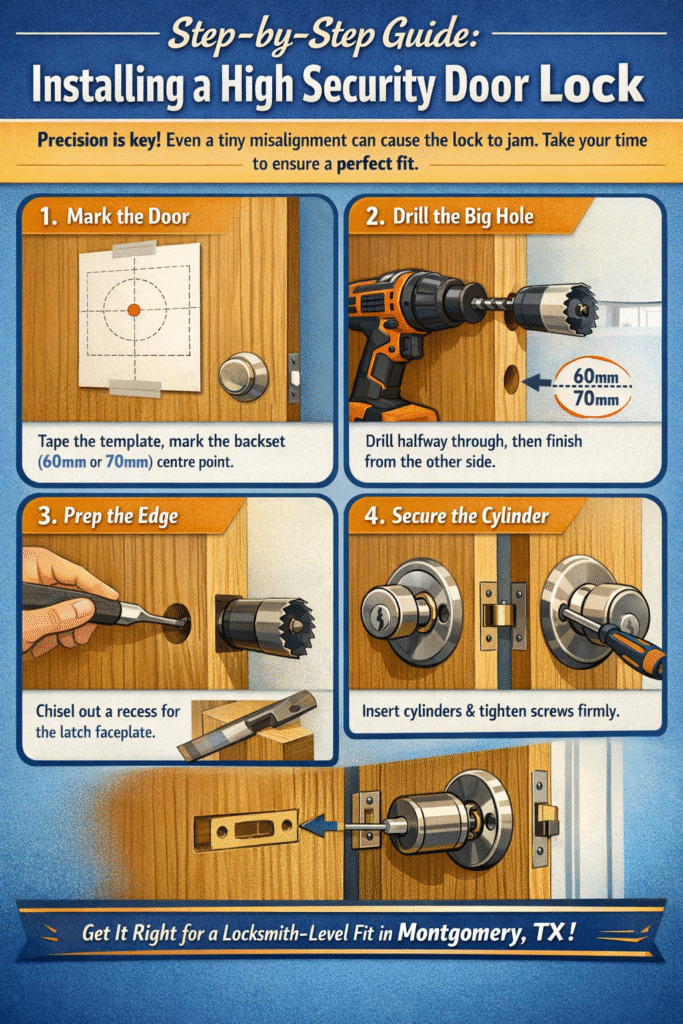
Getting the positioning exactly right is the most important part of the job. High-security locks are made with such tight parts that even being off by a tiny bit can cause the bolt to catch or stop the key from turning properly. Taking your time here ensures the lock works as smoothly as a professional fit from a locksmith in Montgomery, TX.
1. Mark the door: Grab the paper template that came in the box and tape it to the door. You need to be 100% sure about the “backset”, the distance from the door edge to the centre of the hole, which is usually 60mm or 70mm. Mark that centre point clearly so your drill doesn’t wander.
2. Drill the big hole: Use a hole saw bit, but don’t try to go all the way through from one side. Drill until the tip of the bit just pokes through the back of the door, then stop. Go around to the other side and finish the hole from there; this keeps the wood from snapping or splintering.
3. Prep the Edge: Drill the latch hole through the side of the door. Place the latch in the hole, trace around the faceplate, and use your chisel to create a shallow recess so the plate sits perfectly flush.
4. Secure the Cylinder: Slide the bolt into the side of the door and insert the exterior and interior cylinders. Thread the mounting bolts through by hand first to avoid cross-threading, then tighten them firmly with a manual screwdriver.
Common mistakes to avoid when installing a high security door lock
Even with the best hardware, a single error during the fitting process can leave your property vulnerable. Many DIY enthusiasts focus solely on the lock itself, overlooking the small details that actually provide the strength. Learning common mistakes to avoid when installing a high security door lock is vital to ensuring your high security locks in Navasota, TX, provide the level of protection you expect.
- Overtightening the Screws: Using a power drill to drive the final screws into the cylinder can warp the internal housing. This leads to a “sticky” lock that is hard to turn or eventually jams completely.
- Neglecting the Strike Plate: If you use the short screws included in most basic kits, the plate will rip out of the frame with one kick. Always swap these for 3-inch hardened steel screws that anchor into the house stud.
- Ignoring the Backset: A lock that is too close or too far from the door edge will not align with the strike plate. Always double-check your measurements before you start drilling.
- Forgetting to Lubricate: High-security cylinders have complex internal pins. A small amount of graphite-based lubricant ensures the key turns smoothly and prevents metal-on-metal wear over time.
Related Blog:-
What to Do If Your Child Gets Accidentally Locked Inside a Room
Beyond the Lock: Why is hardware only half the battle?
A high-security lock is only as robust as the door and frame supporting it, as intruders often target structural weaknesses rather than the cylinder itself. To achieve a professional standard similar to a locksmith in Texas, you must reinforce the entire entryway to prevent the door from being bypassed.
- Hinge Reinforcement: Replacing standard hinge screws with 3-inch hardened steel versions prevents the door from being pried open from the back.
- Door Integrity: High-security hardware should only be fitted to solid timber or composite doors, as hollow-core materials will simply split under pressure.
- Frame Anchoring: To match the quality of high security locks, the strike plate must be anchored deep into the wall studs to distribute the force of an impact.
Why is Rekey Xpress the ultimate security partner?
While fixing things yourself is a great way to learn about your home, some security upgrades need specific tools and a level of precision that only a professional can offer. A small mistake, like a hole that is slightly off-centre, can actually weaken high security locks in Willis, TX, causing them to jam or fail right when you need them most.
What Rekey Xpress brings to your doorstep:
1. Precision Tools: Our team uses professional-grade jigs and boring equipment to make sure every lock sits perfectly flush. This eliminates the “sticky” or dragging feeling that often happens with DIY installations.
2. Expert Guidance: We take the guesswork out of security ratings. Our team makes sure the hardware you pick actually fits your specific door and meets the safety or insurance standards needed for your property.
3. Mobile Workshops: Our vans are fully equipped to handle any job on the spot. Whether your door frame needs a bit of extra work or you need a smart key programmed, we get it all done in a single visit.
Your Local Experts for High-Security Solutions
Upgrading your home security is a journey that starts with high-quality hardware and ends with the peace of mind that your family is safe. By learning how to install commercial grade high security door lock systems properly, you have taken a massive step toward creating a more resilient and protected household.Expertise makes the difference between a lock that works and a lock that never fails, especially when you need an affordable locksmith in The Woodlands. At Rekey Xpress, our 24/7 mobile teams are ready to provide professional calibration and elite security installations whenever you need them. Contact Rekey Xpress today to book your high-security lock installation and ensure your home remains fully protected.
Also Read This Blog:-
How to Rekey a Lock in The Woodlands: A Complete Home Security Guide
Frequently Asked questions
Q1. Can I put a high-security lock on a regular wooden door?
Yes, as long as the door is solid wood and not hollow. Just make sure the door is thick enough to hold the new lock before you start drilling any holes.
Q2. Is a Grade 1 deadbolt actually worth the extra money?
Definitely. Grade 1 is the strongest rating you can get for a home. It is built to handle much more force and is much harder to pick than a cheap, standard lock.
Q3. Will I need special keys that are hard to copy?
Most of these locks use “restricted” keys. This means a random shop can’t copy them; only an authorized locksmith can, which keeps you in control of who has access to your home.
Q4. How long does the installation usually take?
If everything goes smoothly, it takes about 30 to 60 minutes. It might take a little longer if the door frame needs extra work or if the parts don’t line up perfectly at first.
Q5. Does doing it myself mess up my home insurance?
It might. Some insurance companies in the UK want a professional to fit the locks to guarantee they work properly. It’s best to check your policy first so you don’t lose your coverage.